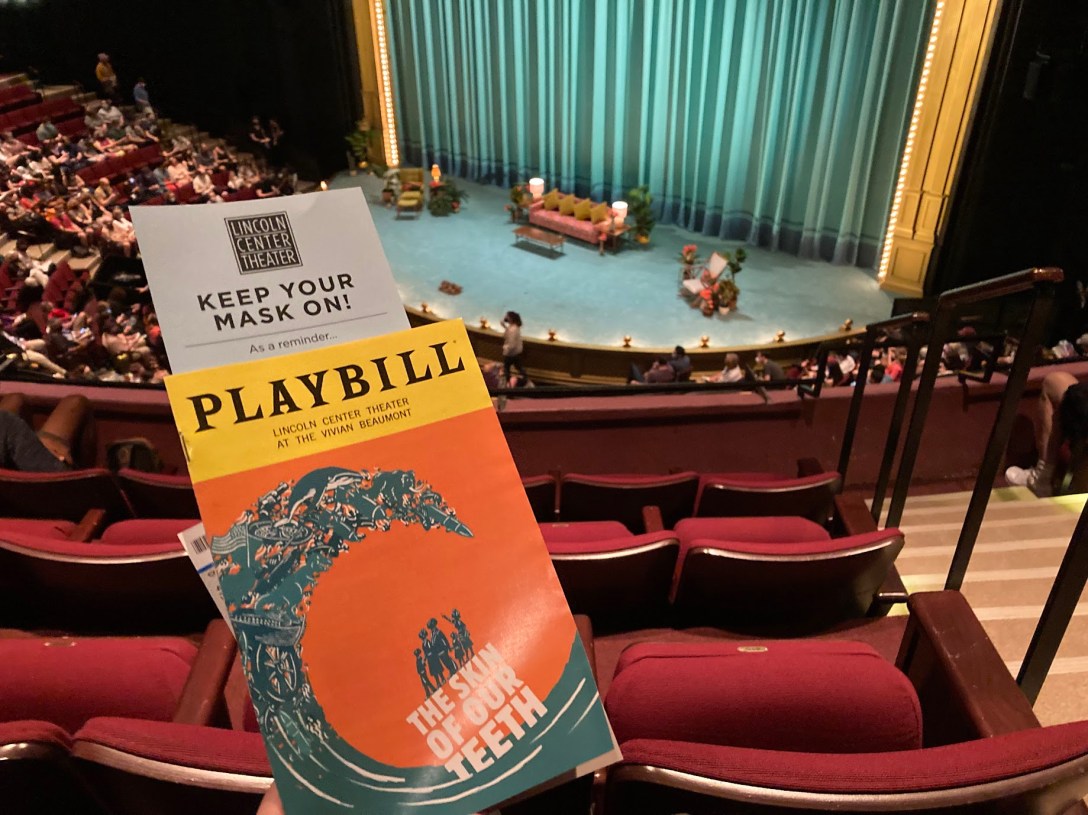
In my years of seeing shows at Lincoln Center’s Vivian Beaumont Theater, I’ve never been able to publish a review for the news outlet I’m affiliated with at the time. This is usually because newspaper production is closing/is already closed as the show is going on or the stage production is closed by the time newspaper production resumes again. Luckily, I have my own website to post my own LCT reviews.
When “Flying Over Sunset” was closing, I thought “In Retrospect” was an apt review title for a show set in the ‘50s. Here I am using it again for a show set in the ‘20s, or at least in seems like it is set in the ‘20s.
Unlike the previous, lengthy review for FOS, I intended for the review for “The Skin Of Our Teeth” to be be 450-500 words, so as long as my theatre review column for The Ticker’s arts and culture section. However, because I found it difficult trying to explain the story and characters without giving too much away and confusing the readers not familiar with the play, it’s shaping up to be 600 words. For reference, I usually leave this context to one or two paragraphs.
Per my personal style, there will be Oxford commas in the following review.
I was drawn to its reputation in the absurdist comedy genre, and I wasn’t disappointed. Beyond the stage, I’d like to applaud the person who edited the montage for the show. With clever cuts and musical cues, it was superb. I just wish there was some archival footage of Gabby Beans’ Sabina voice out on the internet.
The revival of Thornton Wilder’s Pulitzer Prize-winning “The Skin Of Our Teeth” at Lincoln Center’s Vivian Beaumont Theater will close on May 29.
The original 1942 production of Wilder’s apocalyptic comedy excited its audience by using absurdist humor and breaking the fourth wall on stage.
Directing this production in coincidence with the playwright’s 125th birthday, Lileana Blain-Cruz refreshes the show for a modern audience that is coming to terms with a pandemic, racial reckoning and natural disasters. At this time, this revival could not be more relevant.
Summarizing what the entire play is about in one paragraph may be difficult, but this helps illustrate how complex the story is despite its humor.
The play follows melodramatic housemaid Sabina — who is the only character who interacts directly with the audience — as she works for the middle-class Antrobus family of New Jersey in the 1920s.
The hot-tempered Mr. Antrobus represents the human race and invents of many things — notably, the wheel and alphabet — as Mrs. Antrobus tries to be an attentive wife and mother while trying not to play second fiddle to Sabina. Daughter Gladys boasts her good school work while son Henry threatens to stone people to death — originally named “Cain,” the latter killed his brother. At one point, they have a mammoth and a brontosaurus for pets, acted by puppeteers.
In addition to the characters in the play, the performers themselves — in this production, actually playing fictional versions of themselves with different aliases — break the fourth wall by addressing problems with the production. Sabina’s performer, fictionalized in-show as Latasha Somerset, blatantly expresses her confusion with Wilder’s work, and every instance of her doing so makes the audience chuckle.
In the show’s three acts, the world either seems to end or starts anew from natural and human-made disasters, but as absurd everything seems to be, it is all tied well at the resolution. Although the story delivers strong witty lines, Wilder successfully shifts into serious dialogue between the Antrobus couple and Sabina, particularly in the climax of the third act.
Who stands out in this production is Gabby Beans. Perhaps directed to for this show, she speaks in a high-pitched, Eartha Kitt-like voice as Sabina while reverting to her normal voice when reverting to Latasha. Regardless, she sells the performance. Her comedic delivery is on point in every act, not to mention the down-to-earth delivery of her final lines. It is no wonder why Beans received a Tony Award nomination.
On stage, the set design is undoubtable impressive. In the first act, the designers rig the stage to make seem as if it’s going to collapse — aptly, Adam Rigg is nominated for the show’s scenic design. The second act astounds the audience a marvelous boardwalk set, even with a three-story slide that cast members go down during the show. The third act’s post-apocalyptic set includes an overgrown garden that remains beautiful despite the torn surroundings.
Also worth highlighting but not short of attention is the Tony-nominated costume design by Montana Levi Blanco. Her designs for the first and third acts give off a homey vibe that is appropriate for the setting, though confusing may be time periods they’re set it, given Sabina’s ’50s-style uniform, the Antrobus men’s Union Army-style uniforms and the Antrobus women’s Reconstruction-era dresses.
Nevertheless, the costume designs for the second act’s scene in Atlantic City evokes the playfulness and color of the Roarin’ Twenties. The music choice and choreography for the scene should not be brushed over as well, as they reinforce the mood of the period, not to mention Sabina’s fierce moves.
At the heart of this review, the show should not be missed, and there’s only one chance left to see it as of the publication of this post. It may not sit well for those resistant to the play’s ridiculous logic, or lack of, but it is only a play with an uplifting message, after all.
***
