I thought “In Retrospect” was an apt title for an in-depth review about a musical set in 1957. Here I am using it again to reflect on and provide more insight on my theatre reviews for The Ticker.
At the very least, I’d like to acknowledge copy, fact and web issues.
ISSUE 6 — “Confederates”
This theatre column started when my professor suggested to my playwriting class to see this new play by Dominique Morisseau, whose other play “Skeleton Crew” was showing on Broadway at Samuel J. Friedman Theatre. Naturally, I turned this idea into work for The Ticker, and suggested to classmates that we could co-write a 450-word review and proposed a theatre review column. I wasn’t the only one who saw the show, but I ended up being the only one to write a review. Still, the column was encouraged by my professor, and I pitched the column to the newspaper’s arts and culture editor.
“Confederates” was the show I first reviewed for a college student audience. I had a lot to work with, considering that I saw it on a student night that featured Morisseau and three other panelists in conversation. What I stuck to me was the dark comedy. The climax at the end is designed to bring discomfort — at least, among characters who aren’t — amid a revelation
CORRECTION: I’d like to acknowledge that Morisseau’s name is misspelled as “Morriseau” in this piece. It’s an odd thing to be missed by the editing team, given that we are trained to fact-check names, especially with my section.
ISSUE 7 — “Company”
I got into the show in late 2019 by listening to the cast albums from 1970, 2006 and 2019. I also saw the professional recording of the 2011 performance at the New York Philharmonic. I was drawn to the show not just for Stephen Sondheim’s music and Patti LuPone but also to see how George Furth’s story was modernized.
I’m glad to say that I was able to book a cheap seat in the front row. Then again, I saw it in the dead of January, when the omicron variant of the coronavirus raised concerns, when the cold weather usually keeps people from seeing shows and when there were concerns of people being attacked on the subway given the recent deadly push at the Times Square station.
I’d like to note while Sondheim is a composer and lyricist, he is a playwright in his own right by telling the story in his music, hence the decision to credit him as such. If anyone takes issue with this, please forgive me, but I will stand by my opinion.
ISSUE 8 — “Beetlejuice”
I don’t have a lot to say about this review other than that I was tempted to write in more puns than there are in the published article. I wrote the review unsure if it was going to be uploaded in the hours before or after the show’s opening, given articles are usually uploaded on Fridays. In this case, they went up on a Saturday morning, so it was a good call to write as if the show already opened.
ISSUE 9 — “How I Learned to Drive”
I also don’t have a lot to say about this review, given that my thoughts on the play were covered here. Looking back, I do love the simplicity of the set. I’ve seen at least one review noting it was lacking, but the acting and the story give so much for audience members to watch and process that the set shouldn’t be their focus.
ISSUE 10 — “Come Together”
When I pitched the column, I also suggested that I’d cover the theatre program’s spring performance to save the arts and culture editor time and energy finding someone else to cover it. Also, I figured last semester’s reporter and reviewer would be busy taking on certain tasks this time around, and she did end up having another story to cover.
I did the behind-the-scenes coverage and the show review. To do this, I saw the show three times: at the first sitzprobe during spring break, at the dress rehearsal and at the opening performance. I wanted to get a full perspective of the show, watching how the performance grew in the days before the show and keep an eye on changes, the latter being very important when one cast member tested positive for COVID-19 before opening night. I ended up making last minute changes to how I’d structure both articles.
If I had to address anything that I didn’t include in the article — because I wrote the articles throughout the night and turned them in the wee hours of the morning, before I presented a final project presentation — it’s that I really appreciated the Ikea bag, lamp and storage box used. I was moved by the powerful vocal talents of the performers since they resonated with the songs. I’d love to see where each of the performers go in their professional careers.
I could compare the show to a jukebox musical given the song selection, but a playlist fit more in my imagination, a playlist one would make to lift one’s spirits.
What still sticks with me, and it was made apparent by my playwriting professor, is that Baruch College’s theatre productions don’t usually have 50 members, even with the technical crew. I could have misheard the line when I was transcribing the interview. I figured it must have been 15, but even that number isn’t the usual number. I’ve been told later that the most people the program has had working in a production is 13, for the previous semester’s “And Then There Was Us.” I suppose there’s more incentive to get more people involved in the college’s productions now.
I’m aware the show was advertised as a musical “review,” but the correct word for the show, as with AP Style in consideration, is a musical “revue.”
Additionally, for the review of the revue, there was originally an editor’s note in all drafts acknowledging that one of the performers is a regular photographer and arts writer for The Ticker. This was done for ethical reasons.
However, based on what I’ve asked the main web editors, it appears that an assistant who uploaded that article neglected the note for some reason. The note is on the print layout as well as the behind-the-scenes article, the latter of which was uploaded by one of the main editors, not the assistant.
ISSUE 11 — “The Minutes”
In case the review and coverage of the musical revue was bumped to the next issue — albeit, doing so would make it less timely — I saw “The Minutes” during spring break.
First and foremost about the review, I’m well aware that the last word of it was cutoff. It should read “nomination,” but I figure that if the show doesn’t win the Tony Award for best new play, I’d say this technical glitch was apt. I was surprised that the show only received one nomination. Noah Reid, Danny McCarthy and Tracy Letts gave strong performances. The lighting design and sound design also deserved something.
There was a lot more insight that I could have written in the review, but I would characterize it as “nice to know” information rather than “need to know” information. I could have noted that the decision to depict Mount Rushmore for he show’s Presidents’ Day social media post was clever, given the history of the mountain and the revelations made toward the end of the show. I also could’ve analyzed the show’s usage of a crow wearing an American bald eagle mask as its symbol, but this was a review, not a thesis.
Letts wrote a well-structured play. What I didn’t get into was Sally Murphy and Austin Pendleton’s spot-on acting. Their characters were mostly there for comic relief, and they really brought in the giggles before the dramatic turn in the show’s latter half.
ISSUE 12 — “A Strange Loop”
I came across Michael R. Jackson’s show when its off-Broadway production was making rounds in the theatre community in 2019. Sadly, I’d only heard about it on its closing date. I was elated to hear of the show’s 2020 Pulitzer Prize win and its 2022 Broadway run.
For the final review of the semester, I wanted to write one for an original musical, following an original play and some revivals. This column gave me more incentive to see the show, happily on a bigger stage with an updated musical arrangement and new leading performer.
While my turn-around time for “Come Together” was short, between me seeing the show and submitting the articles, I had an idea of how both articles would be structured since I saw the show three times within eight days. For “A Strange Loop,” I had the shortest turn-around time of a little over 18 hours, so I felt bad about not being able to write all I wanted in time.
I remember that at the end of “Intermission Song,” I was delighted to see stepping implemented in the number. I wanted to make note of it in the review, but I forgot about it while listening to the version from the off-Broadway cast recording, which does not include the stepping. It came back to me when I was listening to the version from the Broadway cast recording, which was released days after I wrote the review and included the sound of stepping. I don’t see it enough in mainstream entertainment, and I’m glad that I was introduced to the dance form in high school.
I love the balance in seriousness and comedy in the show, as well as the instances where the cast breaks the fourth wall, especially before the closing song. I think I wanted to highlight some of the show’s more emotional numbers, like the last two songs, but I would have spoiled the rest of the show.
I do plan on continuing the theatre column for the rest of year, or at least try to. This column started half way into Volume 121, and I was able to cover a number of the shows because I saw them before the semester.
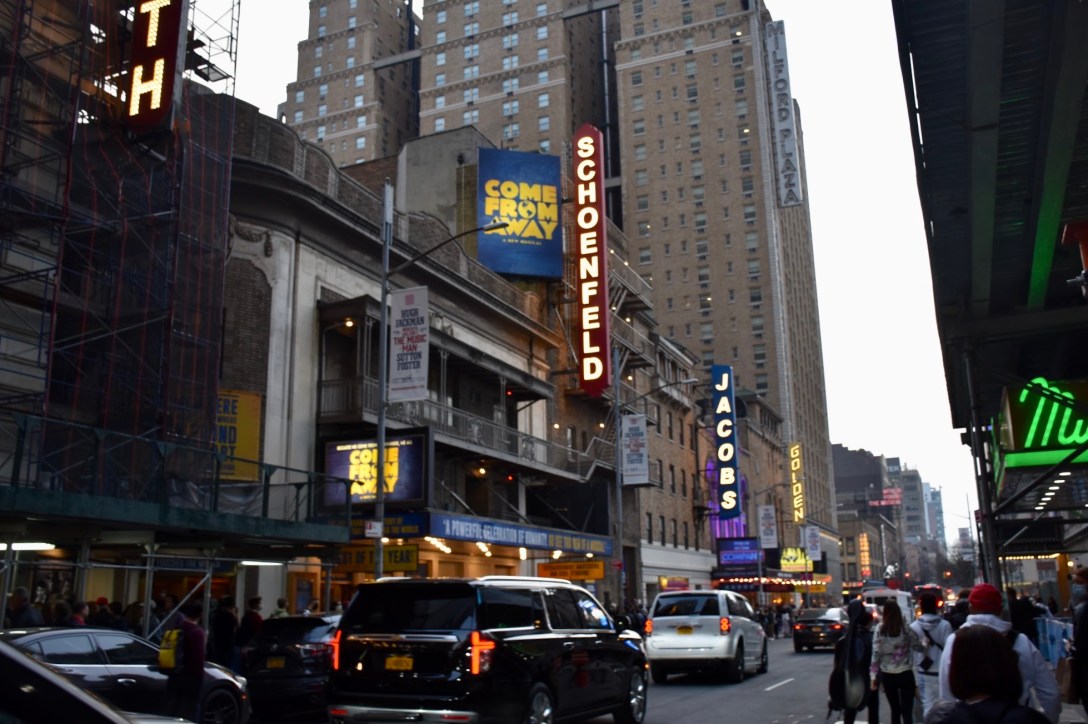
The summer issue might include a review of “Between The Lines,” depending on my ability to acquire tickets, or “Golden Shield,” depending on whether the show is still running. I can guarantee that there will be reviews for “Come From Away” for its fifth anniversary and “The Phantom of the Opera” in light of post-pandemic changes and spooky season. I have high hopes for “Sing Street” finally opening.
***
