Good riddance. The story behind my last planned illustration for the year is long, at least from my perspective, but I at least I can say that there is an illustration.
I had two ideas going into this project. The first idea was to capture a scene from “The Fortune Cookie” (1966), which was the first film that I watched in its entirety in 2021. It starred Jack Lemmon, which is an important detail later on, in his first of many films with Walter Matthau. I spent time in the beginning of the year watching some of his films, from “It Should Happen to You” (1954) to “Buddy Buddy” (1981) — there’s still more I’d like to watch, but I’ll leave it to 2022. I could see Lemmon’s slapstick antics in Jim Carrey. I couldn’t decide on a particular scene from “The Fortune Cookie” that I though my hand could handle drawing, so I scrapped that plan.
The second idea was to capture a scene from “7 Faces of Dr. Lao” (1964), which had me trying to figure out a lot of things. I found myself unable to choose a scene from this film either because it felt wrong, but that outcome felt “right.”
I’ll diverge from the main topic of this post to raise questions I had about aforementioned film. Was the use of yellow-face on Tony Randall, who plays the titular character, justified? I don’t believe there was an intent on being racist. According to a 1975 interview with director George Pal, Peter Sellers was the initial choice for the titular role, but MGM gave the part to Randall because he was cheaper. This film gave Randall a rare opportunity to be the leading man in a film, having played the supporting male friend in a film trilogy with Rock Hudson and Doris Day. In addition, the person who played Dr. Lao also played, as hinted in the title, seven other characters, some including the wizard Merlin, the satyr Pan, and the gorgon Medusa. Almost all the parts Randall played in this film, save for a cameo of him with his bare face posing as a disgusted audience member, involved drastically changing his physical appearance to make him not look like a white male or someone who blends into a small Arizona town in 1935. I tried looking for commentary on Randall’s yellow-face in this film, but there’s barely any. Given what this film is about, the genre it is, and when it came out, there is no doubt this film is overlooked. In addition, when it comes to the sci-fi and fantasy genre in literature and media, the novel that this film was adapted from does not pop up much.
My other questions: Who wrote the novel that this film was adapted from? What inspired that person to write this story? What makes that person think they could tell this particular story? As it turns out, author Charles G. Finney was stationed in China for the US Army and was inspired to write this story after watching an American act express distaste in a famous local tile art while he went sightseeing. This is section of the post is becoming longer than I intended, but to wrap it up, I was so intrigued by the source material that I wrote a research paper this semester on the story it was based on and its author in comparison to Ray Bradbury’s “Something Wicked This Way Comes.” I only saw the movie two days into the semester, and I’m still wrapping my head around the “masterpiece” four months later.
Anyway, I ended up spending more time than I should thinking about Randall’s acting career in addition to watching his films. By luck, Turner Classic Movies aired a marathon of his films on Aug. 26, when I first encounter Dr. Lao. Little did I know, the first film I saw with Randall in was “Boys’ Night Out” (1962) on Jan. 3, and I’d realize it because of the marathon. I became more familiar with the actor through “Will Success Spoil Rock Hunter?” (1957), which in my first view I though he was Tony Curtis, who starred with Lemmon in “Some Like It Hot” (1959). I recently acquired a copy of his autobiography to try and get insight on his performance as Dr. Lao, but he doesn’t bring it up. In fact, he barely brings up sci-fi/fantasy films, but he does shout out his female co-stars Kim Novak, Jayne Mansfield, and Doris Day, but oddly not Barbara Eden. If there’s anything I’m still wondering about after analyzing his career, I wonder why there little said about the fellow television star who, like Day, performed in three films with him.
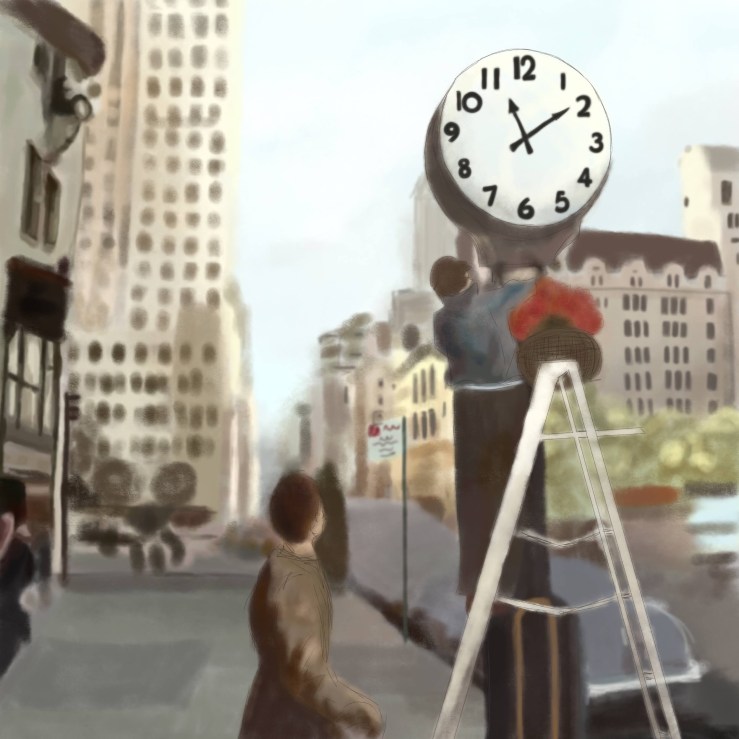
In the end, I settle on this scene of Felix Unger looking at a street clock from the ending credits of the 1970s television adaptation of Neil Simon’s “The Odd Couple.” Randall played as Unger in the show, and he’s the one performing in this scene. Lemmon played Unger in the 1968 movie adaptation. I’d say they look alike from the back, so there is a little bit of both actors in this still of Unger.
I settled on this moment, thinking it was the clock by the intersection of Fifth Avenue and Broadway on 23rd Street, near the Flatiron Building. Something didn’t seem right when I compared the clocks later. Perhaps this was really the part of Fifth Avenue near the Plaza Hotel, but you know what? What’s done is done, and I’m still going to look at the Flatiron clock and think it was the clock.
In conclusion, there are a lot of street clocks on Fifth Avenue, Lemmon and Randall could pass off as brothers, Dr. Lao’s story and the Randall-Eden screen relationship has to be looked into more, and I need new fascinations.
***
